Chicago’s 2024 Young Architects Award Winners on Expanding Access to the Profession, Design Excellence, and Leadership
Dillon Goodson, Affil. AIA Chicago
Ryan Gann, AIA, grew up sketching floorplans, inspired by the celebrity homes he saw on ‘MTV Cribs.’ At a similar age, Richie Hands, AIA, took to the arts, developing an interest in the intersection of creativity and science that lasts to this day. Meanwhile, Carl Sergio, AIA, made a mid-career pivot after searching for a way to put his psychology degree to work. Despite their different pathways, each of these AIA Chicago members found their way to architecture. Last spring, they were recognized — along with more than two dozen of their peers from elsewhere in the U.S. and around the world — with AIA’s 2024 Young Architects Award.
The award program is built on a simple idea: emerging talent deserves recognition. Since the 1990s, AIA has honored young architects with the Young Architects Award, celebrating their exceptional work. Eligible candidates are licensed AIA members who have shown outstanding leadership and made significant contributions to the architecture profession within ten years of their initial licensure. This award is distinct from the AIA Chicago Foundation’s Dubin Family Young Architect Award, which specifically recognizes young architects from the Chicago area.
Consideration for the Young Architects Award begins with a rigorous application process. Candidates must show their dedication to the value of design, practice, or education, as well as their contributions to the profession through mentoring and industry involvement, and their commitment to community service. They must also demonstrate the “ripple effect” they have had on the profession — impact that goes beyond the daily work of their practice or their immediate community.
For the three Chicago-based awardees from the 2024 class, demonstrating such a ripple effect involved emphasizing a mix of program development, speaking engagements, publications, and giving back through mentorship and professional service.
“I often tell people that my career is sort of a partnership between design and service,” said Ryan Gann, who recently sat down for a conversation with Jen Masengarb, Assoc. AlA, and his fellow awardees. He described his recognition through the Young Architects Award as a “great forum” for an architect to look back at an early point in their career and reflect on the impact they have made.
For Gann, who started his own architecture and design practice in 2021 after spending his formative years at Ross Barney Architects, this impact has included working on a range of projects — from business plans to master plans and vision statements to visionary buildings. It has also involved his service as the youngest member to be elected to AIA’s Board of Directors as an at-large director.
Accustomed to navigating an age gap from early in his career, Gann began searching for entry points for his fellow young architects, who he noticed were underrepresented at the table. “I started to…take on this philosophy of bringing my own chair with me into the room and bringing others and opening the door and leaving the door open for others to follow. And that’s…now matured into my current leadership philosophy, which is, if I can shatter the glass ceiling or open a door for someone else, that’s the work,” he said.
Despite efforts to elevate more young professionals into leadership roles, many aspiring architects never make it into the profession in the first place. According to data from NCARB, women represent only about 1 in 4 architects, even though they make up roughly half of the working-age population in the U.S. For people of color, the figure is just 1 in 5.

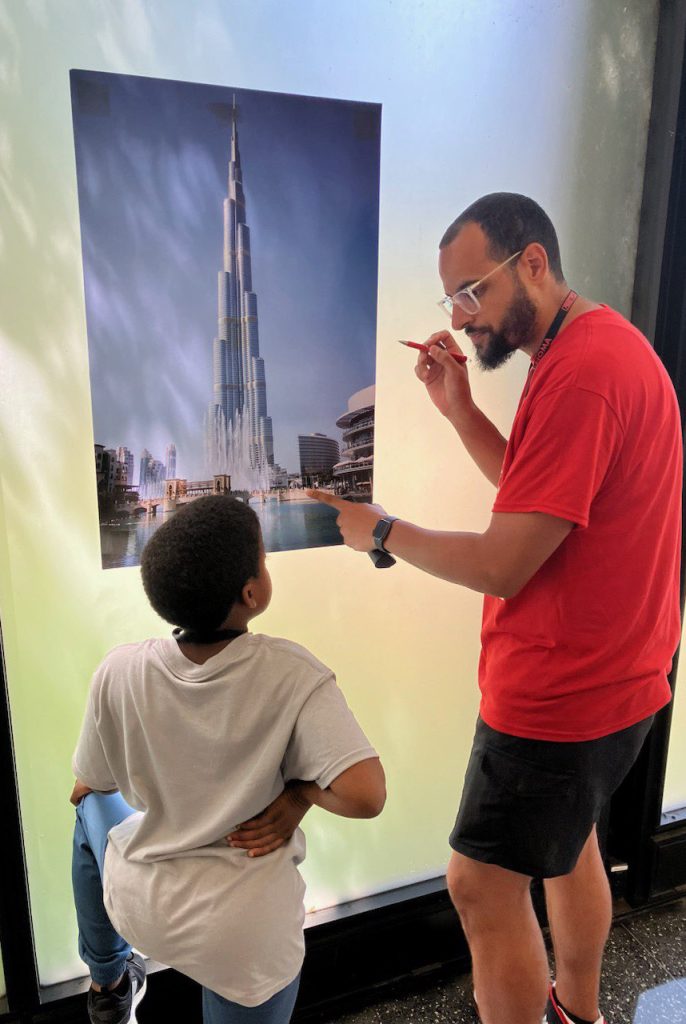
Richie Hands, a senior associate at Lamar Johnson Collaborative, is focused on expanding access to the profession, leading a national movement to engage underrepresented youth in architecture. This work began early in his career, gaining steam after he got involved with the leadership of I-NOMA, the Illinois chapter of the National Organization of Minority Architects (NOMA). Through his involvement, he has helped grow Project Pipeline, the organization’s signature program focused on increasing the number of Black and Brown architects.
In his first year with I-NOMA, Hands expanded Project Pipeline from a 1-day workshop with fewer than 10 students to a 4-day camp with over 80 participants. Over the next two years, the camp grew, adding a half-day kickoff and securing a generous donation from Equity Office, which funded a private tour of Willis Tower. As national chair of NOMA’s Project Pipeline, he aligned the curriculum nationally and led the first online and hybrid camps. In 2023, NOMA held a record 29 camps across 31 cities.
“I’ve always been fairly bullish with [making sure] the quietest voice or, sort of, the lowest on the proverbial org chart had a voice,” said Hands. Thanks to his efforts and those of his peers, NOMA membership has surged from around 800 members in 2018 to nearly 4,000 today. In another encouraging sign, colleges and universities are graduating a larger share of minority architects. As a result, “doubling the number of Black architects in the next five to six years is actually achievable,” he said.

Embarking on a career in architecture is just the first step in a long and challenging professional journey. For many architects, regardless of their background, landing that crucial first job often proves to be the toughest hurdle. Carl Sergio knows this struggle firsthand.
“Part of my origin story…is that graduating was just a real challenge in the [Great Recession]. And I thought it just doesn’t have to be this hard,” said Sergio, a senior project architect at Wright Heerema Architects. “Once I had kind of figured out how to navigate enough to get myself into the field and into AIA Chicago, I just felt like I should do my best to help other people — to make it easier for the next generation.”
Sergio got involved early on with AIA Chicago’s Bridge mentorship program, which connects AIA Fellows with rising professionals in their first three to ten years of practice. A graduate of the program himself, Sergio has helped lead the Bridge program since 2016, which has become a national model for other AIA chapters. During this time, he has facilitated group discussions on career advancement for more than 150 emerging leaders and their FAIA mentors. The diverse backgrounds of each mentee are one of the most rewarding aspects of the work, according to Sergio, and help reinforce that there are many pathways to the profession.
“There’s no one way to be an architect,” he said. “Different people come at it from different perspectives.”
—
AIA’s 2024 Young Architects Award winners were selected by a six-member jury and announced in April. Applications for the 2025 cycle have already closed. For more information and to apply in a future year, visit aia.org/design-excellence/awards.